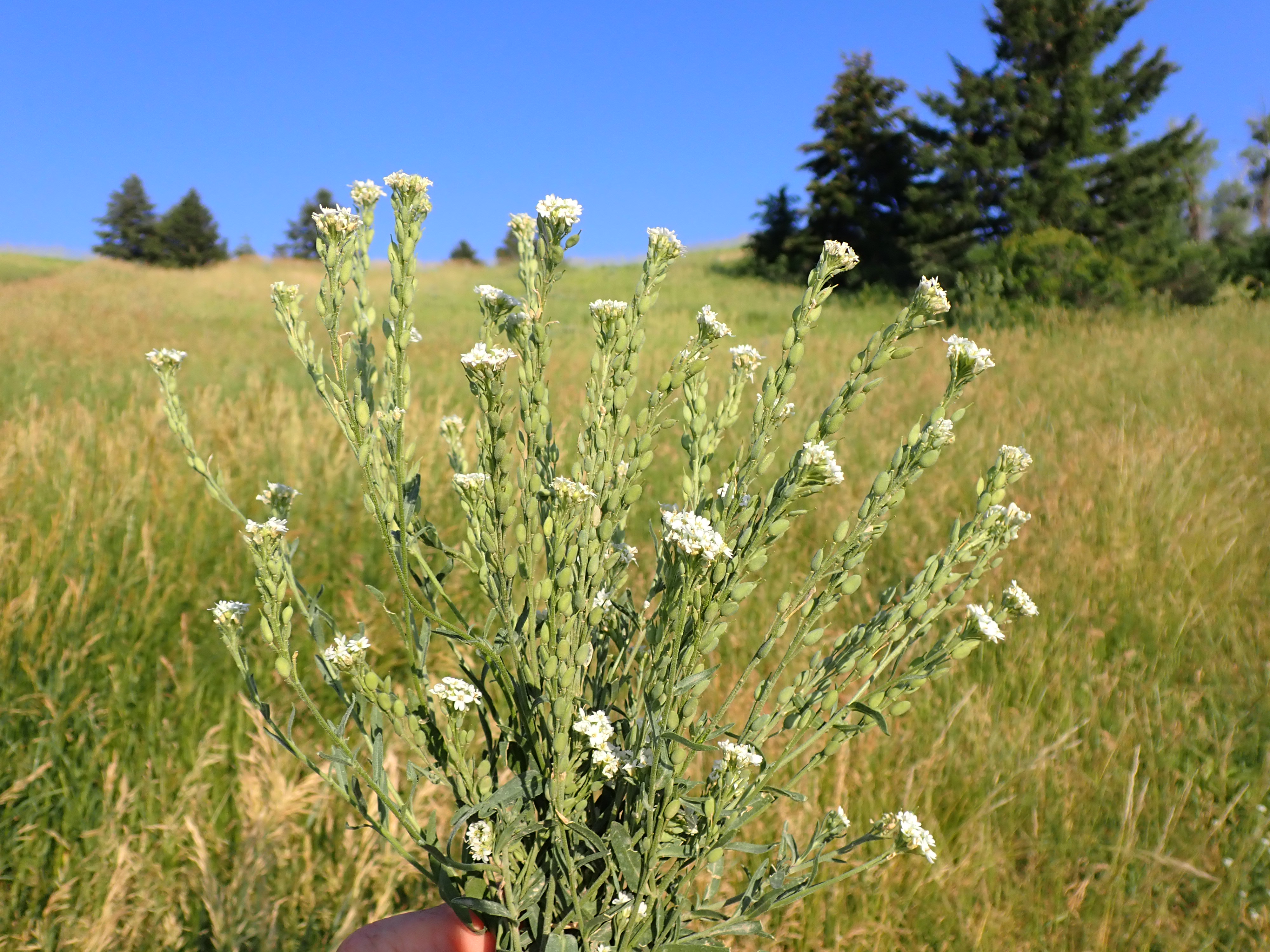
Noxious Weed of the Month: Hoary Alyssum
Author: Allison Kosto, MSU Broadwater County Extension Agent
Article Published: 08/28/2026 Volume: 5 Edition: 08Allison Kosto
MSU Broadwater County Extension Agent
Often confused with pennycress or falseflax, Hoary Alyssum has been increasing in Broadwater County in recent years.
Description & Habitat:
Hoary Alyssum is believed to have come to North America in contaminated clover and alfalfa seed. It was first documented in Montana in 1905 in Gallatin County and can now be found throughout most of the state. Hoary Alyssum prefers sandy soil and thrives in dry and disturbed ground. It can be found along roadsides, gravelly streams, in lawns, and vacant lots. It can also be found in pastures and hayfields. Once established, light is more important for growth and reproduction than water which gives it a competitive advantage over other plants.
As a member of the mustard family, Hoary Alyssum has a deep taproot. Leaves are lance shaped. Stems are erect to semi-erect, growing 7 to 30 inches tall and are usually branched at the top. The plant produces small white flowers that can bloom from early spring to late fall. It has a distinct translucent seedpod that contains 4 to 12 small seeds. Hoary Alyssum normally reproduces as an annual, but if it establishes late in the summer, it can reproduce as a winter annual or biennial. It only reproduces by seed.
Hoary Alyssum can decrease forage quality for livestock and wildlife. However, more importantly, it is toxic to horses in green forage and hay. In hay fields, contamination of 30% or more results in forage or hay that is toxic to horses. It can remain toxic in hay for up to nine months.
Management
Human activity is the primary spreader of seeds. Do not drive or walk in areas that are heavily infested if possible. Research has shown that seeds can travel over 160 miles on a vehicle in dry conditions. Wash vehicles, ATVs and any equipment before going home.
For this plant, reducing or stopping seed production will slow the population and spread. Hand pulling can be effective, but unless you get the root crown it will regrow, so pulling may need to be repeated. Mowing alone will not control hoary alyssum as it can regrow. However, repeated mowing can reduce seed production. There are currently no biological control options available.
There are only a few herbicides labeled for hoary alyssum. Commonly used chemicals include 2,4-D, Chaparral, Escort, Telar, and Opensight. Spring applications are most effective, but research has shown that any application prior to seed set will reduce seed production. Always read and follow the entire label when applying herbicides. Common chemical names are used for clarity but does not imply endorsement of a product or brand.
For assistance on weed identification and control, contact the MSU Extension Office in Broadwater County at 406-266-9242 or the Broadwater County Weed District at 406-266-9243. The Weed District has a cost-share program to help control noxious weeds on private property.
Article Images
Click on Image Thumbnail(s) to view fullsize image
PhotoCredit: Matt Lavin
Image 1 Caption: Hoary Alyssum
Photo Credit: Matt Lavin